Jun.2019
Sitting at the mouth of the Fraser River, the village of Steveston, although technically part of Richmond, BC, retains a unique small town flavour. It’s a flavour that’s heavily influenced by the Japanese immigrants who before the war made up more than two-thirds of the population. Within a few square kilometres are found the Steveston Buddhist Temple, Steveston Martial Arts Centre, Steveston Japanese Canadian Cultural Centre, Murakami House, Kishi Boatworks, Kuno Gardens, Japanese fisherman’s statue, Japanese Hospital plaza, and T. K. Homma Elementary School, among other reminders of the key roll Japanese immigrants and their progeny played in the history of the town. The very existence of these landmarks pays tribute to the close, symbiotic relationship between the Japanese Canadian community and the Village of Steveston. While pre-war relations were often tense, and the return of the community following the lifting of restrictions in 1949 caused unease among some, the ensuing years have seen the Village becomes what Kelvin Higo calls, “the prime example of cultural harmony.”
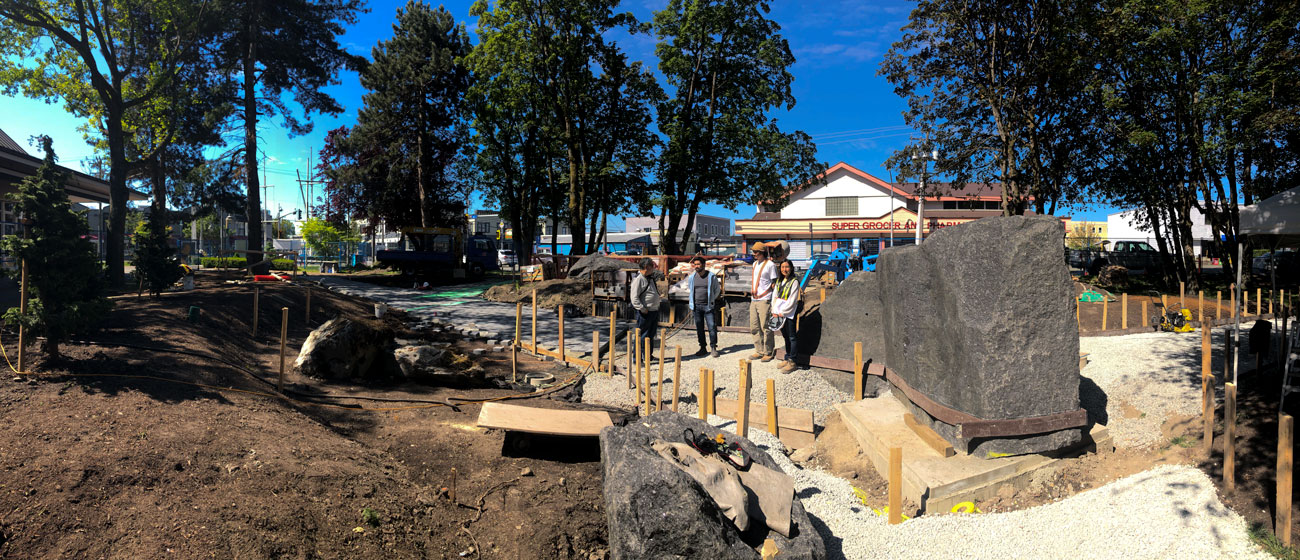
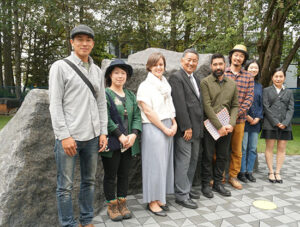
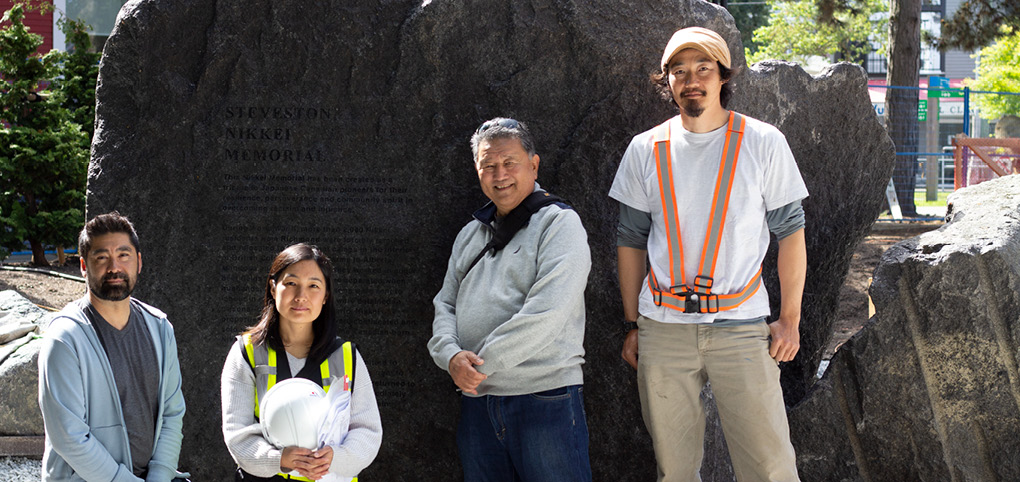
On a warm Wednesday morning, I park my car by the Japanese Hospital plaza and walk onto a fenced-off site at the corner of No. 1 Road and Moncton for a private tour of the new Steveston Nikkei Memorial, still very much under construction, but never-the-less taking shape. Joseph Fry, Kelvin Higo, Hanako Amaya and Hayato Ogawa are waiting for me, standing the shadow at two large black boulders that sit nestled together in a sea of gravel. A few steps away, grey, patterned tiles form a partially-finished path that winds through the site, linking the other elements.
The Steveston Nikkei Memorial project had its genesis in 2017 as a way of marking the 75th anniversary of the removal of the Japanese Canadians from the West Coast. The initial concept was a statue that would sit by the Tram Building, the location where Nikkei left the community between April and May, 1942. City Council approved a grant of $325,000, with the Steveston Community Society donating another $20,000.
The parternship between the City of Richmond, the NNM&CC and the Steveston Community Society created a steering committee to select an artist to undertake the project, with the Hapa Collaborative, led by Joseph Fry, winning the bid.
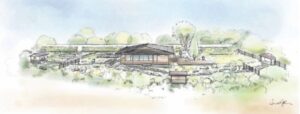
In its final iteration, the memorial hugs the gentle contours of the site, with trees and grass creating a backdrop for the path, the soon-to-be-planted plum tree, and the boulders that are engraved with the history of the community – its expulsion and eventual return.
While three three small boulders were sourced from Tashme, the centre-piece black-coloured boulders come from Quebec. The largest is engraved with the names of the primary internment sites with other markers representing the work camps, the sugarbeat farms, the self-supporting camps and the Ontario POW camps.
Running my hands across the face of the boulder, the tactile nature of the map somehow reinforces the vastness of the land where the Japanese Canadians were exiled, and the rugged beauty of its mountains, rivers and lakes.
Kelvin points out that as part of the fundraising activities, it was determined that a Steveston Nikkei Memorial Legacy Fund should be created to fund education and cultural activities related to the Nikkei community. “We felt it was difficult enough to entice new volunteers without them also having to worry about funding projects or initiatives they wished to pursue. A goal of $100,000 was established and a partnership with the Nikkei National Museum & Cultural Centre was created.”
Talking to Kelvin, what comes up over and over is the concept of working together and the support that the project has received across the board. It is, he points out, the result of good will and trust built up over many years. That spirit of cooperation and dedication is also evident in talking to Joe, Hanako and Hayato – this is truly a labour of love for all the particiants. It is fitting, too, that the project is bringing together contibutors that represent the different aspects of today’s Canadian Nikkei community, where birthplace is but one factor in a connection that crosses oceans, mountains and forests and finds common cause in respect for the pioneers who built today’s community and a desire to honour them.
The community is invited to join the unveiling on Saturday, June 22, nine months to the day from the project’s launch.